Research


Quantum Many Body Dynamics

How do large collections of interacting quantum particles evolve in time? Even when each particle obeys simple rules, their collective behavior can be remarkably rich. Our research focuses on understanding when and how quantum systems reach equilibrium, and on identifying situations where this process breaks down.

Some highlights:

Slow thermalization from integrability breaking

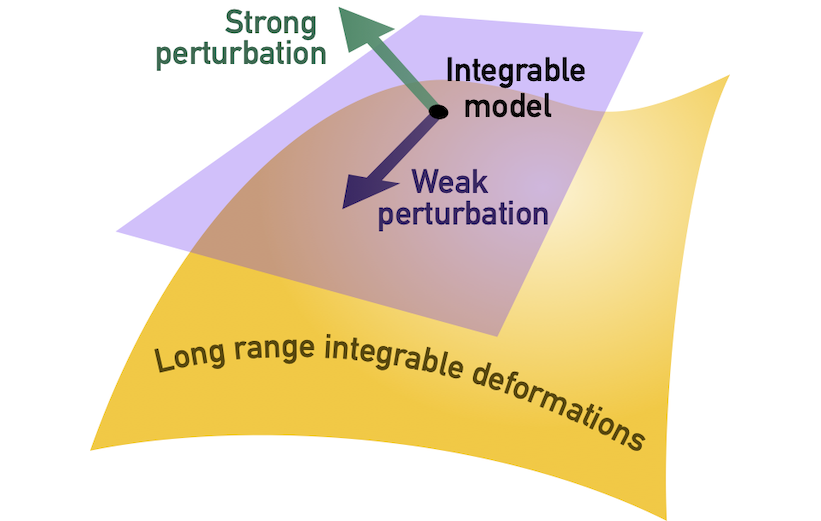
An integrable system, in contrast with a generic ergodic system, has many conserved quantities that constrain its time evolution. When a small perturbation breaks these conservation laws, it is expected to eventually reach thermal equilibrium. Remarkably, we find that the time to reach equilibrium can be significantly longer than expected in many systems of interest.

False vacuum decay and metastability

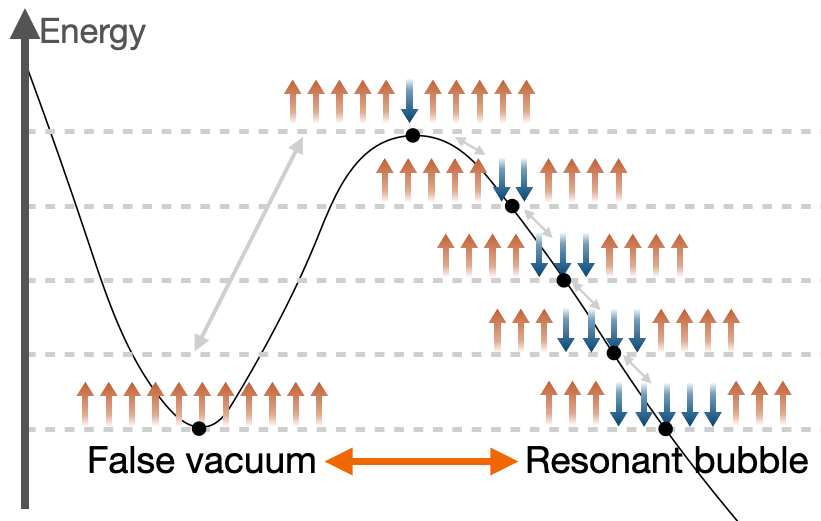
Many systems in nature can remain for a long time in states far from equilibrium, such as supercooled water or the magnetic memory in our computers. This occurs when the system becomes trapped in a local energy minimum. In our research, we focus on understanding how such metastable behavior can arise in quantum many-body systems.

Quantum Simulation

Many systems that obey quantum physics—such as materials with strong interactions or models from high-energy physics—are extremely difficult to study with classical computers. Quantum simulators offer a powerful alternative: they use well-controlled quantum platforms, such as cold atoms or superconducting qubits, to emulate the behavior of these otherwise intractable systems. I work closely with experimental groups to design and analyze quantum simulation protocols that can reveal new phases of matter, probe real-time dynamics, or test fundamental theoretical ideas.


Some highlights:

Quantum simulation of string breaking dynamics

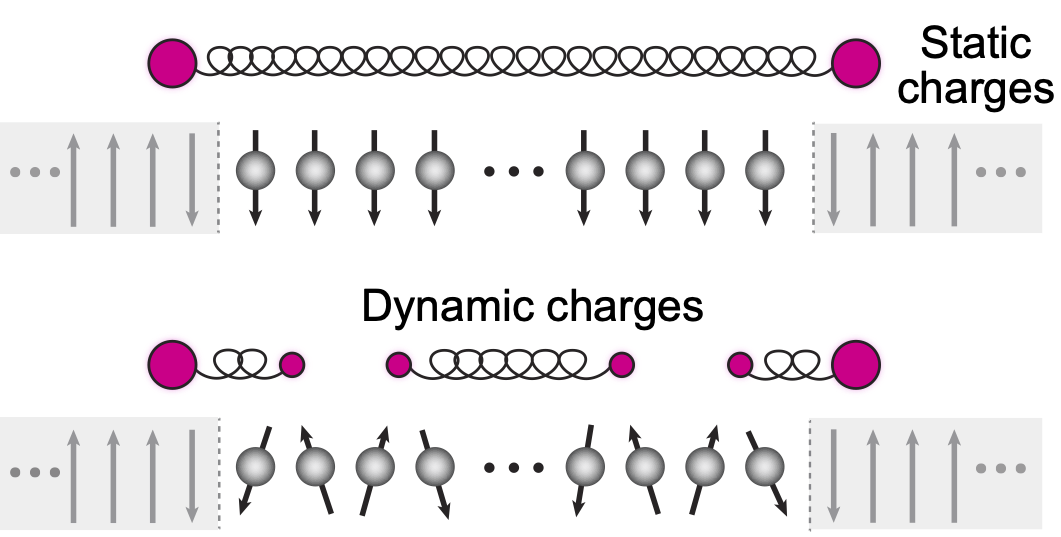
When two particles are bound by a confining potential (such as a quark and an anti-quark), pulling them apart will lead to the creation of additional particles that screen the potential, a process known as string breaking. We have recently demonstrated this phenomenon in a trapped ion quantum simulator.


Quantum simulation of lattice gauge theories

Lattice gauge theories are central to our understanding of the standard model of particle physics and also capture emergent phenomena in strongly correlated systems, such as quantum spin liquids. Realizing these theories controllably in a quantum simulator would allow us to overcome key limitations of classical simulations. In our work, we have proposed implementations of lattice gauge theories on platforms including cold atoms in optical lattices and Rydberg atom arrays, and explored their rich and exotic dynamical behaviors.


Talks